GitOps
Contents
GitOps
Brooks-Security.com
GitHub: LittleSeneca/brooks-security.com
This site builds and ships itself. One public repository holds both the Hugo content you’re reading and the Terraform that runs the AWS infrastructure serving it. I push to main, and GitHub Actions takes it from there: build the site, sync it to S3, invalidate CloudFront, and reconcile the cloud with terraform apply. No servers to babysit, no deploy button to press.
I build in the open on purpose. Most security advice tells you to hide how things work. I do the opposite.
That is Kerckhoffs’s Principle: a system should stay secure even when everyone can see exactly how it works. The secrecy lives in the keys, not in the design. So I don’t hide the design. Read every line of Terraform, trace how the site is built, served, and locked down, and stand up your own copy if you want one. You still can’t break mine, because you don’t hold my keys. I won’t call it unbreakable, because nothing is, but there’s no hidden trick to find. The whole attack surface is a short list of secrets in SSM and a few tightly scoped IAM roles.
Jeff Moser makes the point better than I can, in A Stick Figure Guide to the Advanced Encryption Standard (AES):
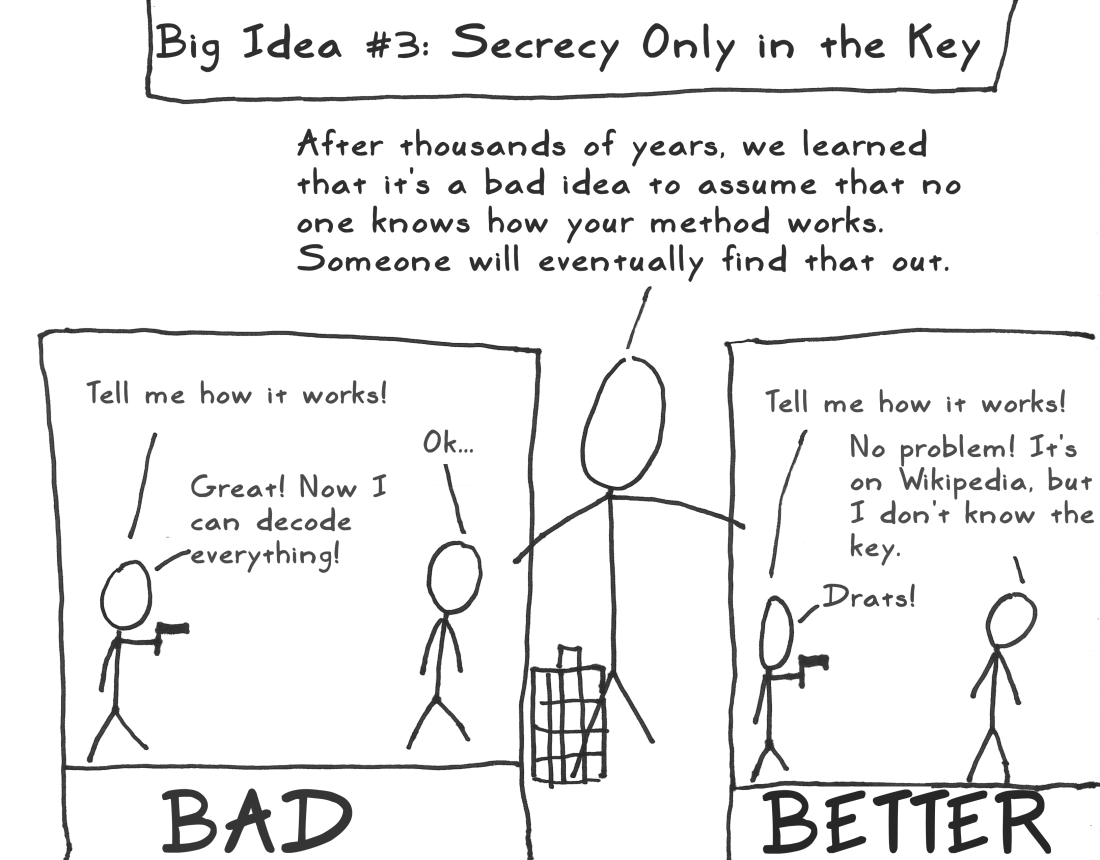
Image: “Big Idea #3: Secrecy Only in the Key,” by Jeff Moser, from A Stick Figure Guide to the Advanced Encryption Standard (AES) (Moserware). Used with permission; all rights remain with the author.
The whole thing runs for roughly $1 a month in AWS.
What runs where
| Layer | Technology |
|---|---|
| Content | Hugo with custom layouts |
| Infrastructure as code | Terraform (terraform/) |
| Hosting | Private S3 origin bucket behind CloudFront |
| DNS / TLS | Route 53 + ACM (DNS-validated) |
| AWS access portal | IAM Identity Center, fronted by a CloudFront 301 redirect |
| Scheduled jobs | EventBridge → Lambda (nightly heatmap refresh) |
| Contact form | API Gateway HTTP API behind CloudFront, with reCAPTCHA Enterprise + SNS email |
| Lead capture | Same API Gateway HTTP API (/api/subscribe) → Lambda that appends to a Google Sheet, authenticated keyless via Workload Identity Federation |
| Secrets | AWS SSM Parameter Store |
| CI/CD | GitHub Actions on GitHub-hosted runners |
What this isn’t: no self-hosted runner, no Ansible, no servers to patch, and no static Google service-account key anywhere. It all runs on throwaway GitHub-hosted runners against AWS.
Repository layout
.
├── .github/workflows/
│   ├── infrastructure.yml      # terraform fmt → validate → plan/apply
│   └── hugo-deploy.yml         # hugo build → deploy → CloudFront invalidation
├── hugo/                       # site content, layouts, config, data/
├── terraform/
│   ├── *.tf                    # s3, cloudfront, route53, acm, iam, sso, lambda, contact, subscribe
│   ├── imports.tf              # import blocks adopting pre-existing resources
│   ├── bootstrap/              # one-time: tfstate bucket + lock table
│   └── files/                  # CloudFront function, Lambda source, google-auth layer (committed)
├── specs/                      # design docs for in-flight work
└── readme.md
How a change ships
Two workflows run on every push and pull request to main. Each uses a paths-filter, so it only does real work when its own files changed. The checks still report either way, so my required status checks pass on every PR.
flowchart TD
    PR["Pull request to main"]
    PR --> INFRA_PR["infrastructure.yml<br/>fmt → validate → plan<br/>(plan posted as PR comment)"]
    PR --> HUGO_PR["hugo-deploy.yml<br/>build (proves it compiles)"]
    INFRA_PR --> MERGE["Squash & merge to main"]
    HUGO_PR --> MERGE
    MERGE --> GATE{"production<br/>environment gate"}
    GATE -->|approve| APPLY["terraform apply<br/>reconcile AWS"]
GATE -->|approve| DEPLOY["hugo deploy<br/>S3 sync + CloudFront invalidation"]- On a PR:
infrastructure.ymlrunsterraform fmt -check,validate, andplan, then posts the plan as a sticky PR comment so the diff is reviewable inline.hugo-deploy.ymlbuilds the site to prove it compiles. - On merge to
main: theapplyanddeployjobs run. Both target theproductionGitHub Environment, so they pause for an explicit approval before touching anything.terraform applyreconciles AWS;hugo deploysyncs the rendered site to S3 and invalidates the CloudFront cache.
Public site architecture
The site is just static files in a private S3 bucket. The bucket blocks all public access. CloudFront is the only thing allowed to read it, through an Origin Access Control and a bucket policy scoped to the distribution’s ARN.
flowchart LR
    V["Visitor"] --> R53["Route 53<br/>apex + www"]
    R53 --> CF["CloudFront<br/>ACM TLS · HTTP/2 · IPv6<br/>'hugo' edge function<br/>(/posts/foo/ → index.html)"]
    CF -->|cache miss<br/>via OAC| S3["S3 origin (private)<br/>AES256 at rest<br/>no public access"]
    S3 --> CF
    CF --> V
hugo deploy reads the [deployment] block in hugo.toml: it pushes hugo/public/ to s3://brooks-security.com, sets long-lived Cache-Control headers on hashed assets, and invalidates the distribution. A small CloudFront Function (terraform/files/hugo-cf-function.js) runs at the edge on every viewer request and turns Hugo’s pretty URLs into the underlying index.html keys, so directory-style links resolve at the edge without an origin round trip.
AWS access portal: aws.brooks-security.com
I run a second, tiny CloudFront distribution for one reason: to give the IAM Identity Center login page a memorable address. Its only origin is a dummy. A CloudFront Function intercepts every request and returns a 301 to the real Identity Center portal URL. No compute, no S3, just a redirect at the edge.
Terraform manages the identity side too: the Identity Center user, an AdministratorAccess permission set, and the account assignment that binds them. (I have to enable IAM Identity Center by hand in the console once before Terraform can manage these resources.)
Nightly contribution-heatmap refresh
The homepage shows a GitHub-style contribution heatmap, rendered as static inline SVG from hugo/data/contributions.json. That file is re-baked once a day so the calendar stays current without a human in the loop:
flowchart TD
    EB["EventBridge<br/>cron 09:00 UTC"] --> L["Lambda: contrib-dispatch (python3.12)<br/>reads GitHub PAT from SSM<br/>(/github/admin_token)"]
    L -->|"POST workflow_dispatch"| WF["hugo-deploy.yml"]
    WF --> Q["build step queries GitHub GraphQL<br/>contributionsCollection API"]
    Q --> J["overwrite hugo/data/contributions.json"]
    J --> D["redeploy → S3 + CloudFront"]
I kick the workflow from EventBridge instead of a GitHub Actions schedule: cron on purpose. GitHub auto-disables scheduled workflows after 60 days of repo inactivity, which a personal site can easily hit. EventBridge never sleeps. The whole job is one Lambda invocation a day, basically free, and the fetch is fail-soft: any error leaves the last good JSON in place so the build still succeeds.
Contact form
The contact page has a working form, and adding it didn’t change the cost or the shape of the architecture. One CloudFront behavior routes /api/contact to an API Gateway HTTP API, so the browser posts to the same origin it loaded from, with no CORS to wrangle. Nothing is always-on; I pay per request for both API Gateway and Lambda.
flowchart TD
    B["Browser<br/>reCAPTCHA Enterprise token"] -->|"POST /api/contact"| CF["CloudFront<br/>/api/contact behavior<br/>injects shared-secret header"]
    CF --> AG["API Gateway HTTP API<br/>(proxy integration)"]
    AG --> L["Lambda<br/>brooks-security-contact (python3.12)"]
    L --> V{"verify"}
    V -->|"Enterprise createAssessment<br/>+ shared secret + honeypot"| OK["publish to SNS"]
    OK --> EM["email to me"]
The Lambda does three things: confirm the request actually came through CloudFront (via a secret header CloudFront injects, so the public API can’t be hit directly), create a reCAPTCHA Enterprise assessment for the token and reject invalid tokens or low scores, then publish the message to an SNS topic that emails me. Verification uses a Google Cloud API key and the owning project rather than a classic secret key. The API key and public site key live in SSM; the site key is also baked into the Hugo build at build time, and the Lambda reads both at runtime, neither entering Terraform state.
This is the kind of result I want from picking the right building blocks: a dynamic feature, with bot protection and email delivery, bolted onto a static site for a rounding error. API Gateway’s HTTP API is pay-per-request, about $1 per million calls, which for a contact form rounds to zero. A real backend that adds no always-on infrastructure and no meaningful cost.
Signup capture, keyless into Google Sheets
A second route on the same API Gateway HTTP API (/api/subscribe) captures form signups into a Google Sheet, reusing the contact form’s whole anti-abuse posture: the CloudFront origin secret, reCAPTCHA Enterprise, and a honeypot. It backed a lead-magnet landing page that is no longer published, but the endpoint is worth writing up for how it authenticates to Google, because it does it without a key.
Google’s organization policy here blocks service-account key creation outright, which is the right default. So instead of a static key sitting in SSM, the Lambda uses Workload Identity Federation: its AWS execution role federates into GCP and impersonates a keyless service account, and only that service account is shared on the Sheet.
flowchart TD
    B["Browser<br/>reCAPTCHA Enterprise token"] -->|"POST /api/subscribe"| CF["CloudFront<br/>/api/subscribe behavior<br/>injects shared-secret header"]
    CF --> AG["API Gateway HTTP API<br/>(proxy integration)"]
    AG --> L["Lambda<br/>brooks-security-subscribe (python3.12)"]
    L --> V{"verify<br/>secret + reCAPTCHA + honeypot"}
    V -->|"exchange AWS identity"| STS["GCP STS<br/>token exchange"]
    STS -->|"impersonate"| IAM["IAM Credentials<br/>generateAccessToken"]
    IAM --> SH["Sheets API<br/>append row"]
The trust chain runs entirely on identity, no shared secret crosses the boundary. GCP’s workload identity pool is pinned to the exact assumed-role ARN of the brooks-security-subscribe role, so only that Lambda can federate. It exchanges its AWS identity for a short-lived GCP token at Google’s STS endpoint, then impersonates the service account to get an access token, then appends the row. The only out-of-band material is the federation config (identifiers, not a secret) and the spreadsheet id, both in SSM and read at runtime. There is no key to leak, rotate, or commit by accident.
The one dependency this adds is google-auth, for the token exchange, shipped as a Lambda layer whose build is committed to the repo so it stays visible and reproducible. The rest of the handler is standard library, including a small urllib transport so the federated refresh and the Sheets call never need a heavier HTTP dependency.
Terraform state & bootstrap
State lives in an S3 backend (brooks-security-tfstate) with a DynamoDB lock table. A small terraform/bootstrap/ module creates both once; its own state is local and committed to the repo, which is the usual chicken-and-egg escape hatch. The main config adopts the resources that already existed through terraform/imports.tf: import blocks that pull live Route 53, ACM, S3, and CloudFront under management, so the steady-state plan is a clean no-op.
Security model
| Control | What it does |
|---|---|
| Ephemeral GitHub-hosted runners | CI runs on disposable runners with no path into any private network; there is no long-lived self-hosted runner to compromise |
| Plan on PR, apply on merge | terraform plan runs read-only on PRs; apply only runs after merge to main |
| Production environment gate | apply and deploy jobs target the production GitHub Environment, requiring explicit approval before they execute |
| First-time contributor approval | GitHub requires a maintainer to approve workflow runs on PRs from contributors with no prior merged PR |
| Private origin | The S3 bucket blocks all public access; only CloudFront can read it, via Origin Access Control |
| Secrets in SSM | The GitHub PAT (heatmap job), the reCAPTCHA Enterprise API key + site key (forms), and the subscribe path’s federation config + spreadsheet id all live in SSM Parameter Store and are referenced by ARN, never pulled into Terraform state |
| Keyless Google access | The subscribe Lambda writes to Google with no service-account key. It federates into GCP via Workload Identity Federation and impersonates a keyless service account; the workload identity pool trusts only the brooks-security-subscribe role’s assumed-role ARN |
| Least-privilege IAM | The deploy credentials and all three Lambda roles are each scoped to the minimum actions they need (S3 + CloudFront for deploys; SSM read + scoped KMS decrypt for the heatmap Lambda; the same plus single-topic SNS publish for the contact Lambda; SSM read + scoped KMS decrypt for the subscribe Lambda, which reaches Google purely through federated identity) |
| Bot protection | Both forms gate submissions with reCAPTCHA Enterprise scoring and a honeypot field, dropping bots before they reach the inbox or the Sheet |
| CloudFront-only backend | The contact and subscribe APIs are publicly reachable but each Lambda rejects any request missing a secret header that only CloudFront injects, so the APIs cannot be invoked directly |
On deploy credentials: right now the workflows authenticate to AWS with a scoped IAM user’s access keys, stored as GitHub Actions secrets and passed through the standard credential chain (no profile in CI). I’ve already defined a GitHub OIDC provider and a dedicated deploy role in terraform/iam.tf, staged for a cutover to short-lived, keyless credentials. When that lands, the static keys go away.
What it costs
| Service | Monthly cost |
|---|---|
| Route 53 hosted zone | ~$0.50 |
| S3 storage + requests | ~$0.01 |
| CloudFront (low traffic, two distributions) | ~$0.01 |
| Lambda + API Gateway + EventBridge (heatmap + contact + subscribe) | ~$0.00 |
| SNS (contact-form emails) | ~$0.00 |
| ACM, SSM, IAM, Identity Center | $0.00 |
| Google Sheets API (lead capture) | $0.00 |
| Total | ~$1/month |
Neither the contact form nor the lead-capture path moved this total. That’s what I get for sticking to serverless, pay-per-use pieces and reusing what I already run, instead of bolting on a managed service for every new feature. The subscribe path even reused the contact form’s API Gateway and origin secret outright, so the second feature cost a route and a Lambda, nothing more.